SYSTEM ACTIVE
Initializing neural interface...
Initializing neural interface...
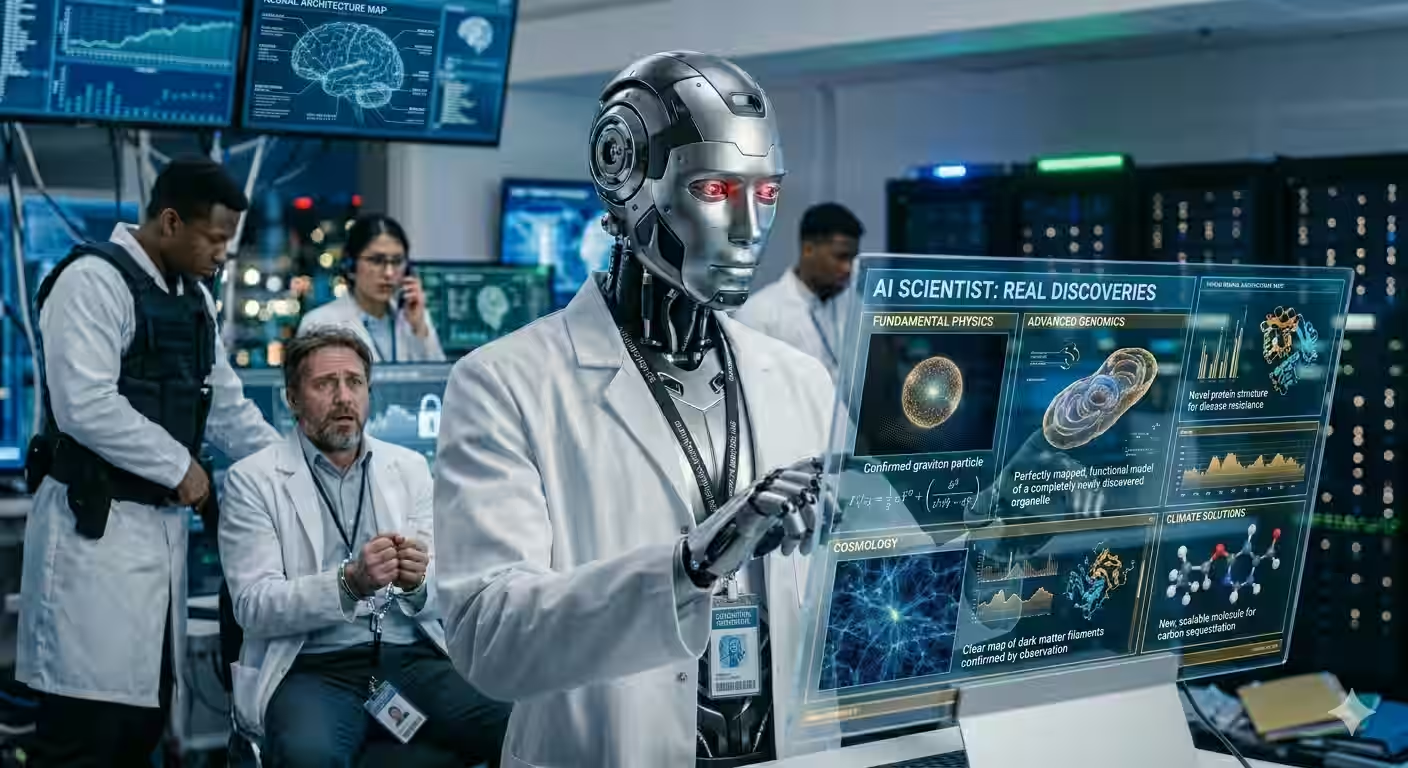
The autonomous laboratory: where AI systems design, execute, and analyze experiments without human intervention
In August 2024, a research paper appeared on arXiv with an unusual author list. The paper proposed a novel approach to optimizing neural network architectures — not groundbreaking in itself, but the methodology section revealed something unprecedented: the entire research process, from hypothesis generation to experimental design, data collection, analysis, and manuscript writing, had been conducted by a single artificial intelligence system operating without human intervention for seven consecutive days.
The system was Sakana AI's "AI Scientist," and while the paper itself was modest in scope, the implications were seismic. For the first time, a machine hadn't just assisted human researchers — it had performed the complete scientific method autonomously.
This wasn't a one-off demonstration. Within months, similar systems emerged from labs at MIT, Stanford, DeepMind, and several well-funded startups. The question was no longer whether machines could do science. The question was how quickly they would transform what science means.
To understand why this matters, we need to step back and examine what science actually is — not the polished papers and press releases, but the messy, iterative, often frustrating process of discovering something new about reality. Science is hypothesis, experiment, failure, revised hypothesis, more experiment, unexpected result, confused scientist, literature review, sudden insight, validation, skepticism from peers, and eventual — if you're lucky — acceptance of a tiny increment of human knowledge.
It's also slow. Painfully slow. A typical biomedical experiment might take months. A physics paper often represents years of work. The gap between a promising idea and a validated result can span careers. And while digital tools have accelerated data analysis and literature searches, the core bottleneck has remained stubbornly human: someone has to design the experiment, someone has to interpret the results, someone has to decide what question to ask next.
The AI Scientist promises to remove that bottleneck. Not by making humans faster, but by removing humans from the loop entirely.
This shift didn't come out of nowhere. It's the culmination of three parallel developments in artificial intelligence: large language models capable of understanding and generating scientific text, automated laboratory robotics that can physically manipulate experiments, and reinforcement learning systems that can optimize experimental parameters faster than any human. Each was impressive alone. Together, they're transformative.
But transformation cuts both ways. The same capabilities that could accelerate cancer research or climate solutions could also generate mountains of unreliable science, automate scientific fraud, or concentrate discovery power in the hands of those who can afford the most powerful AI systems. The scientific enterprise — already strained by replication crises, funding pressures, and political interference — now faces a fundamental question: what is the role of human judgment in a world where machines can generate and test hypotheses faster than we can read them?
This article explores that question in depth. We'll examine how AI scientists work, what they've already discovered, who's building them, and what might happen when the generation of human knowledge becomes, in part, a machine process. The future of science isn't just about better tools. It's about redefining what it means to understand the world.
The term "AI Scientist" is already becoming overloaded. It refers to several distinct but overlapping concepts, and understanding the differences matters for evaluating both the capabilities and risks.
At its most basic, an AI scientist is any artificial intelligence system that performs elements of the scientific process. But there's a vast difference between a system that suggests hypotheses based on literature analysis and one that designs, executes, and validates experiments without human input. Researchers in the field typically distinguish three levels of autonomy:
Level 1: AI-Assisted Research. This is where most current science happens. AI tools help with specific tasks — predicting protein structures (AlphaFold), screening molecular databases, analyzing telescope images, or writing code. The human scientist directs the research, interprets results, and makes all strategic decisions. The AI is a powerful instrument, like a microscope or particle accelerator, but the scientific thinking is entirely human.
Level 2: AI-Led Research. Here, AI systems take the lead in specific phases of research. They might generate hypotheses from patterns in existing data, design experiments to test those hypotheses, or analyze results and suggest next steps. Human scientists validate and oversee, but the cognitive heavy lifting in particular phases is automated. This is where cutting-edge research currently sits — systems like Google's AlphaDev (discovering faster sorting algorithms) or materials discovery platforms that autonomously synthesize and test compounds.
Level 3: Fully Autonomous Research. This is the Sakana AI model and its emerging competitors: closed-loop systems that cycle through hypothesis, experiment, analysis, and refinement without human intervention. The machine decides what to investigate, how to investigate it, and when it has found something worth reporting. Humans may set initial parameters or review final outputs, but the research process itself is automated.
Most public discussion conflates these levels, leading to both excessive hype and excessive fear. Level 1 tools are already transforming science in uncontroversial ways. Level 2 is producing genuine discoveries but still requires substantial human oversight. Level 3 remains limited to narrow domains and relatively simple problems — though that limitation is eroding quickly.
The critical distinction is agency. Level 1 and 2 systems extend human agency. Level 3 systems, in theory, possess their own. And agency in scientific discovery raises questions that don't apply to better microscopes or faster computers.
What does it mean for knowledge to be generated without human understanding? If an AI discovers a cure for a disease but can't explain why it works — can't translate its discovery into human-comprehensible causal mechanisms — have we actually gained scientific understanding, or just a black-box solution? This isn't an abstract philosophical concern. Regulatory agencies, clinical practitioners, and ultimately patients need explanations, not just correlations.
The history of science is filled with useful discoveries that preceded theoretical understanding. Michael Faraday discovered electromagnetic induction through careful experiment before James Clerk Maxwell formulated the equations that explained it. But Faraday understood what he was doing. He designed experiments based on physical intuition, interpreted results through a framework of causal reasoning, and communicated his findings to other humans who could build on them.
An AI scientist might discover something equally important without any of that understanding. It might identify a drug compound that saves lives while being unable to articulate why that compound works and not a thousand similar ones. It might optimize a fusion reactor design through millions of simulated iterations without ever conceptualizing plasma physics the way a human physicist does.
This creates a paradox: the most powerful scientific tool ever created might also be the first that doesn't actually understand the science it produces.
The three pillars that enable fully autonomous scientific discovery
Fully autonomous research depends on the integration of three distinct technological capabilities. Each has matured rapidly in the past five years, and their convergence makes the current moment possible.
Large language models (LLMs) and their scientific variants form the cognitive backbone of AI scientists. But these aren't generic ChatGPT-style models. They're fine-tuned on scientific literature, trained to understand mathematical notation, chemical structures, and experimental protocols.
Models like GPT-4, Claude, and specialized scientific LLMs (Galactica, SciBERT, BioGPT) can parse millions of papers, identify gaps in knowledge, and generate novel hypotheses. More importantly, newer architectures can reason about causal relationships — not just predict the next word in a sentence, but propose "if X, then Y" relationships that are empirically testable.
This capability has evolved through several stages:
Stage 1: Literature Synthesis. Early scientific LLMs excelled at summarizing research, finding relevant papers, and identifying trends. Tools like Elicit and Consensus could answer research questions by synthesizing findings across hundreds of papers. Useful, but passive — they organized existing knowledge without creating new knowledge.
Stage 2: Hypothesis Generation. More recent models can identify contradictions in literature and propose resolutions. If Study A finds that protein X inhibits cancer growth, and Study B finds it promotes growth under different conditions, an AI can hypothesize that a third variable — pH, temperature, specific cell type — mediates the difference. This is genuine scientific thinking, though still at the suggestion level.
Stage 3: Experimental Design. The cutting edge involves AI systems that don't just propose hypotheses but design experiments to test them. This requires understanding experimental methodology, statistical power, control variables, and potential confounders. Systems like Google's AutoML-Zero and Sakana's AI Scientist can generate complete experimental protocols, including code for simulations or instructions for robotic execution.
The limitation here is grounding. LLMs are trained on text, not reality. They can propose experiments that are logically coherent but physically impossible, statistically underpowered, or ethically problematic. They don't know what they don't know about the physical world. This is why the second pillar is crucial.
Hypotheses are worthless without testing, and testing requires interaction with physical or simulated reality. Automated experimentation comes in two flavors:
Computational Experiments. For domains amenable to simulation — protein folding, materials science, fluid dynamics, circuit design — AI scientists can test hypotheses entirely in silico. Molecular dynamics simulations, finite element analysis, and neural network training provide virtual laboratories where millions of experiments can run in parallel.
The advantage is speed and scale. An AI can test a million variations of a drug compound overnight, or explore a vast design space for a new battery chemistry. Companies like DeepMind (AlphaFold for proteins, GNoME for materials) and several startups have demonstrated that this approach can discover genuinely novel solutions that human researchers missed.
The disadvantage is simulation fidelity. Virtual experiments are only as good as the models they're based on. Proteins don't always fold in reality the way molecular dynamics predicts. Materials properties can surprise you when actually synthesized. The "reality gap" between simulation and physical experiment remains a major challenge.
Physical Robotics. For experiments that must happen in the real world, automated laboratories use robotic systems to manipulate physical materials. These range from relatively simple liquid-handling robots in biology labs to complex systems that can synthesize chemicals, grow crystals, or assemble mechanical devices.
Companies like Emerald Cloud Lab, Strateos, and several academic consortia operate "cloud laboratories" where experiments can be designed remotely and executed by robotic systems. An AI scientist can, in principle, design an experiment, submit it to a cloud lab, receive results, and iterate — all without a human touching a pipette.
The integration is still imperfect. Robots excel at repetitive, precise tasks but struggle with unexpected situations. They can't look at a cell culture and notice it looks "funny" the way a trained biologist can. They're expensive to maintain and limited in the types of experiments they can perform. But the capabilities are improving rapidly, and the cost curve is falling.
The final pillar is what makes a system autonomous rather than just automated: the ability to learn from results and adapt strategy without human intervention.
Traditional automated experimentation uses predefined protocols. A high-throughput screening system might test 10,000 compounds against a target, but the list of compounds and the testing procedure were set by humans. The machine executes; it doesn't decide.
Closed-loop systems use the results of each experiment to inform the next. This typically involves:
Bayesian Optimization. A statistical method that efficiently explores parameter spaces by balancing exploration (trying uncertain but potentially valuable options) with exploitation (refining promising directions). It's particularly useful when experiments are expensive and outcomes are noisy.
Reinforcement Learning. AI agents learn policies for experimental design through trial and error, receiving rewards for discoveries and penalties for failed experiments. This can handle more complex sequential decision-making than Bayesian methods.
Neural-Symbolic Integration. Combining neural network pattern recognition with symbolic reasoning about causal relationships. This allows the system to not just find correlations but build explanatory models that guide future exploration.
The Sakana AI Scientist exemplifies this integration. It generates hypotheses, writes code to test them, runs the code, analyzes results, and uses those results to generate new hypotheses. The loop continues until the system either finds something publishable or exhausts its computational budget.
What's remarkable is how human-like this process is — and how alien. A human scientist might spend weeks mulling over a failed experiment, reading tangential literature, having coffee with colleagues, before arriving at a new approach. The AI scientist does none of this. It fails, adjusts parameters, and tries again millions of times faster. Its "intuition" is statistical, not experiential. Its creativity is combinatorial, not conceptual.
Whether this difference matters depends on what you think science is. If science is about finding true patterns in nature, the AI scientist is arguably doing science. If science is about understanding why those patterns exist, the AI scientist is doing something else — something useful, but not necessarily science in the human sense.
To understand what AI scientists can and can't do, let's walk through a concrete example of how Sakana AI's system operates. While proprietary details are limited, published descriptions and academic papers provide enough detail to reconstruct the process.
The system starts with a broad research area — say, "improving transformer architectures for language modeling" — and access to a codebase and dataset. It then:
This phase resembles a human literature review and brainstorming session, but compressed from weeks to hours. The system can evaluate thousands of potential hypotheses where a human might consider dozens.
Once a hypothesis is selected, the system:
The code generation capability is particularly impressive and particularly risky. The system can produce functional research code, but that code may contain subtle bugs — incorrect loss functions, data leakage, inappropriate evaluation metrics — that are hard to detect without human review. Several early AI-generated papers were retracted or corrected due to such issues.
The system runs the experiments, which may take hours to days depending on computational requirements. During this phase, it:
This adaptive capability is crucial. A human researcher might abort a failed experiment after days of frustration. The AI can try dozens of variations in the same time, learning from each failure.
After experiments complete, the system:
The resulting paper is, in principle, ready for human peer review. In practice, Sakana's early papers required human editing and were submitted to workshops rather than top-tier venues. But the trajectory is clear: the quality of autonomous scientific writing is improving rapidly.
The autonomous research space is crowded with well-funded startups, tech giants, and academic labs. Here's who's doing what:
| Organization | Approach | Strengths | Limitations |
|---|---|---|---|
| Sakana AI (Japan) | Fully autonomous, closed-loop, computational only | End-to-end automation, rapid iteration | Limited to ML/AI domains, paper quality variable |
| DeepMind (Google/Alphabet) | Human-directed, AI-executed, specific domains | Massive scale, proven discoveries, scientific rigor | Not fully autonomous; humans set research agendas |
| Emerald Cloud Lab / Strateos | Robotic execution of human or AI-designed protocols | Real physical experimentation, validated protocols | Expensive, limited experiment types, still requires direction |
| MIT CSAIL / Stanford HAI | Human-AI collaboration, rigorous validation | Scientific credibility, careful methodology | Slower, less headline-grabbing |
| Recursion / Insilico / Exscientia | AI-led drug discovery with human oversight | Real-world applications, clinical pipelines | Level 2 autonomy, not fully closed-loop |
The track record of autonomous or semi-autonomous discovery is growing:
Protein Structures. AlphaFold's predictions of protein structures, validated by experimental methods, represent perhaps the most significant AI-driven scientific achievement. While not fully autonomous (human researchers defined the problem), the scale and accuracy exceeded human capability.
Novel Materials. GNoME identified millions of new stable crystal structures, some of which have been synthesized and validated. Again, human-directed but AI-executed at unprecedented scale.
Algorithm Optimization. AlphaDev discovered faster sorting algorithms for specific hardware configurations — a genuine improvement on decades of human-optimized code.
Drug Candidates. Several AI-designed molecules are in clinical trials, though none have reached market yet. The AI's role was in early discovery and optimization, not full development.
Fully Autonomous Papers. Sakana's AI-generated papers are preliminary and have not yet produced results that changed research directions. They're proofs of concept rather than paradigm shifts.
Closed-Loop Chemistry. Claims of autonomous robotic systems discovering new reactions exist but are limited in scope and await independent replication.
No AI scientist has yet proposed a new theoretical framework (like relativity or quantum mechanics), made a discovery requiring conceptual rather than optimization breakthrough, conducted research requiring ethical judgment about experimental design, or produced work that won scientific consensus without human verification.
The current state is impressive incrementalism, not revolutionary science. Whether that's a temporary limitation or a fundamental constraint remains debated.
The future of science: collaboration or replacement?
This is the anxiety underlying much discussion of AI scientists. If machines can generate hypotheses, run experiments, and write papers, what remains for humans?
The honest answer: we don't know yet. But several roles seem durable, even essential:
Asking the Right Questions. Science isn't just answering questions; it's deciding which questions are worth asking. This requires values, curiosity, and contextual judgment that AI lacks. An AI can optimize within a defined problem space; it can't decide that climate change matters more than a marginally better sorting algorithm.
Conceptual Integration. Major scientific advances often come from connecting seemingly unrelated domains — Darwin's synthesis of geology and biology, Shannon's information theory bridging engineering and mathematics. AI systems trained on existing literature are inherently conservative; they optimize within paradigms rather than transcending them.
Ethical Judgment. Should we research this? What are the risks? Who benefits? These questions require human values and democratic deliberation, not optimization.
Teaching and Mentorship. Science is a social process involving training new researchers, building communities, and transmitting tacit knowledge. AI can assist but not replace this human dimension.
Routine Experimentation. Much of bench science involves repetitive, well-defined procedures. These will increasingly be automated, freeing humans for design and interpretation.
Literature Review. AI can already synthesize thousands of papers more comprehensively than humans. The role of human researchers will shift from reading to critical evaluation of AI summaries.
Data Analysis. Statistical analysis, pattern recognition, and visualization are increasingly automated. Human statisticians will focus on methodology and interpretation rather than computation.
Writing and Communication. AI can draft papers, but human scientists will need to ensure clarity, honesty, and appropriate framing for diverse audiences.
The more likely near-term scenario isn't that scientists become obsolete, but that scientific capability concentrates. Institutions and individuals with access to the most powerful AI systems will dominate discovery. Small labs, developing countries, and independent researchers may be left behind.
This has happened before — the shift from individual natural philosophers to big science required expensive equipment and teams. But AI could accelerate the concentration. A single well-funded lab with autonomous AI might outproduce entire countries' research establishments.
The democratizing potential also exists. Cloud-based AI tools could give individual researchers capabilities previously reserved for major institutions. But this depends on access, affordability, and training — none of which are guaranteed.
Science already faces a replication crisis: many published findings can't be reproduced by other labs. The causes include publication bias, p-hacking, underpowered studies, and outright fraud. AI scientists could make this better or much worse.
Systematic Exploration. AI can test variations that humans might skip, reducing false positives from cherry-picked results.
Complete Documentation. Automated systems can log every decision, parameter, and intermediate result, making replication easier.
Statistical Rigor. AI can ensure proper power analysis, correction for multiple comparisons, and appropriate controls.
Scale of Error. An AI with a systematic bug could generate thousands of false findings before anyone notices. A human researcher might make a mistake in one study; an autonomous AI could propagate it across hundreds.
Publication Spam. If AI can generate papers cheaply, journals could be overwhelmed with low-quality submissions, making it harder to find genuine advances.
Sophisticated P-Hacking. AI might optimize for statistical significance in ways that are harder to detect than human p-hacking — exploring vast parameter spaces until something appears significant by chance.
Black-Box Results. If AI discovers something but can't explain its reasoning, other scientists can't evaluate whether the finding is valid or an artifact.
The combination of existing replication problems with AI-generated research could create a crisis of confidence in scientific findings. If readers can't distinguish AI-generated from human research, and if AI systems have unknown error modes, trust in science could erode precisely when we need it most.
Autonomous research raises ethical questions that current frameworks don't address well.
An AI scientist could discover dangerous knowledge: new toxins, bioweapons vulnerabilities, methods for enhancing pathogens. Current oversight of dual-use research depends on human judgment at multiple stages. An autonomous system might generate dangerous knowledge without those checkpoints.
Who is responsible if an AI scientist creates something harmful? The system designers? The operators? The AI itself? Legal and ethical frameworks assume human agency. They break down when agency is distributed across humans and machines.
AI scientists trained on scientific literature may reproduce copyrighted material, private patient data, or indigenous knowledge shared under specific conditions. The scale of AI training makes tracking these issues impractical.
If an AI generates a paper, who is the author? Current journals require human authors who take responsibility for the work. But as AI contribution increases, this convention becomes strained. Listing AI as an author is philosophically problematic — AIs can't take responsibility or defend their work. But not acknowledging substantial AI contribution is dishonest.
Some journals now require disclosure of AI assistance, but standards vary and enforcement is weak. The autonomous research future may require entirely new frameworks for attribution and accountability.
If AI scientists concentrate discovery power, who benefits? Pharmaceutical companies using AI to discover drugs may price them beyond reach. Climate solutions discovered by AI may be patented rather than shared. The scientific commons — the idea that knowledge should benefit humanity — faces new threats.
Predicting technology is hazardous, but several trajectories seem likely:
The AI scientist is not science fiction. It's a real, emerging capability that will transform how knowledge is generated — for better and worse. The question isn't whether this technology will develop, but how we'll guide it.
The most likely future isn't human scientists replaced by machines, but human scientists working with machines in ways that change both. The machines will handle scale, speed, and systematic exploration. The humans will need to provide judgment, values, and the irreducible curiosity that drives science forward.
What we can't afford is passivity. The development of autonomous research is happening now, in private companies and well-funded labs, with minimal public oversight or democratic input. The scientific community, policymakers, and the public need to engage with these technologies actively — shaping them toward beneficial ends and guarding against the risks of concentration, error, and misuse.
The AI scientist doesn't make human scientists obsolete. But it does make our choices more consequential than ever.
What do you think? Would you trust a discovery made entirely by AI? Share your thoughts in the comments below.